Distributed Intelligence with Privacy-Preserving Features for FTTR Networks
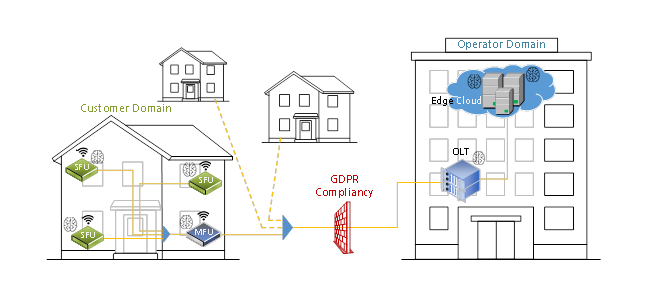
This F5G PoC demonstrates the application of privacy-preserving Distributed Intelligence (DI) in Fiber-to-the-Room (FTTR) networks through the deployment of an FTTR testbed comprising one Main FTTR Unit (MFU), three Sub FTTR Units (SFUs), and dedicated Computing Nodes (CNs). The infrastructure supports the development and execution of DI pipelines for intelligent network monitoring and automation.
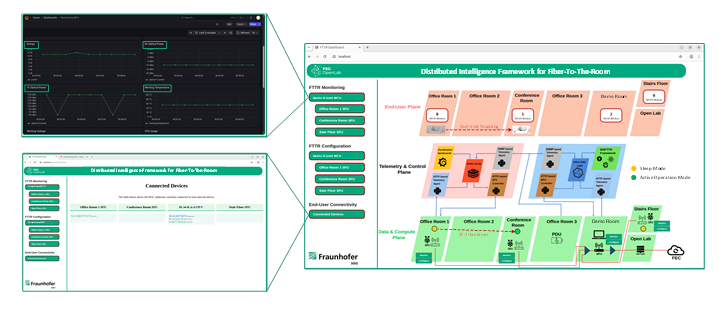
A key contribution of the PoC is the implementation of a novel FTTR telemetry and control framework, including software modules, APIs, and closed-loop control mechanisms for telemetry collection, analysis, and network management. The framework was integrated and validated across FTTR network elements (as shown in the figures below) to ensure reliable communication, interoperability, and seamless operation.
The PoC further demonstrates an observe-analyze-act (OAA) closed-loop model, where DI pipelines continuously collect telemetry data and autonomously optimize network behavior. For example, during a Virtual Reality (VR) gaming session, the system tracks user mobility across rooms and dynamically reconfigures FTTR access points, balancing service performance and energy efficiency. These capabilities are exposed through a centralized web-based graphical user interface (GUI), providing an end-to-end view of the entire FTTR domain.
To assess its benefits, the FTTR deployment was benchmarked against a conventional Fiber-to-the-Home (FTTH) setup. The evaluation considered key performance indicators such as latency, jitter, wireless coverage, and user experience. Results show that the FTTR architecture, enhanced by distributed intelligence, significantly outperforms the traditional FTTH service delivery, achieving up to an order-of-magnitude improvements in delay and jitter in latency-sensitive and bandwidth-intensive applications such as real-time VR gaming, while delivering superior coverage, service continuity, and Quality of Experience (QoE).
M. Sica et al., "Distributed Intelligence Framework with Privacy-Preserving Features for FTTR Network Monitoring and Automation,“ in Optical Fiber Communication Conference (OFC 2026), Los Angeles, CA, USA, M3Z.8, 2026, DOI: https://doi.org/10.1364/OFC.2026.M3Z.8.